Sunday, 23 October 2005

EUROPEAN UNION & THE TAMIL STRUGGLE EU Credibility on the Line


I am a Sinhalese from the majority community in Sri Lanka. I am a doctor of Medicine with no political affiliations or ambitions. I left Sri Lanka 30 years ago and the only reasons for my involvement are concerns that are humanitarian and the future of the country. I have had a longstanding interest in the on-going ethnic conflict, in particular, in achieving a solution which enables the Tamil ‘minority’ to live with equality, safety, dignity and without discrimination, in the country of their birth. I have supported the Tamil people in their struggle against a succession of Sri Lankan (read Sinhalese) governments who conceive of Sri Lanka as a Sinhala-Buddhist nation which effectively excludes the Tamils, a concept that is even enshrined in the Constitution.

A fundamental problem is the failure to recognize the historical fact that Sri Lanka (then Ceylon) was not a single nation but three effectively separate kingdoms (nations), the Tamil Kingdom in the North, the Kandyan (Sinhalese) in the Centre, and the Low-Country (Sinhalese) Kingdom in the South. This separation existed for hundreds of years until the colonial British, for administrative convenience, unified the country.
When they quit (1948) they handed over the country to Governments that were, and will always be, dominated by the majority (74%) Sinhalese. Discrimination against the minorities, especially the industrious Tamils, was always a possibility, and was, in fact, articulated strongly by Tamil politicians when the British quit. This possibility became reality as competing Sinhalese political parties adopted more and more discriminatory policies against the Tamils in language, education, employment and the developmental neglect of the area in which the Tamils lived.

Over the next 50 years Tamil politicians have negotiated with a succession of Sri Lankan governments to address these problems. A series of pacts between the two groups have not been implemented, even torn up, unilaterally by the Sri Lankan government to gain the political support of the majority. The initial request of the Tamils was for a Federal State in the Tamil area. The response of the Government was to unleash violence on peaceful Tamil protests and to increase the discriminatory measures. It was then that the Tamils pressed for a Separate Tamil State (Eelam). It is important to appreciate that the Tamils are not trying to divide and destroy a country but to reverse a British colonial policy which had clearly not worked.

It was not the LTTE but the Tamil people who, in the 1977 General election(the last with a credible result) voted overwhelmingly for a Seperate Tamil State and gave their elected parliamentarians a mandate to pursue such a result. It was the abysmal failure of these elected representatives to make any headway using democratic means that resulted in the Tamil militants picking up arms to establish such a goal by force, much as what Nelson Mandela and the ANU did to get the racist South African government to abandon its policy of apartheid.
Had the Tamil militants not gone the way they did, the elected representatives of the Tamil people would still be grovelling at the feet of Sinhala politicians as they have done over the past 50 years. There would have been no Peace Talks or a search for any solution to address the problems faced by the Tamil ‘minority’. Had Mandela and his group not acted in the way they did to take on the South African government, apartheid would still be flourishing in South Africa. To White South African eyes, Mandela was a terrorist who should be jailed (and was), to international eyes he was a statesman who deserved a Nobel Prize (and got it). So also Yasser Arafat, another Nobel Prize winner, leader of the PLO whose acts of violence dwarfs anything that the LTTE have done.
If some of Sri Lanka’s political leaders who have directed the mass killings of Tamil civilians and the Heads of the Armed Forces who carried these out (which included mass ‘disappearances’ of those in their custody, some of whom were tortured and buried alive), are taken before the International Court in the Hague on a charge of genocide, I doubt if they will go unscathed.

The EU declaration

In the context outlined above, the recently released EU statement condemning one party ot the on-going negotiations puts the credibility of the EU on the line.
1. The declaration condemns the “continuing violence and terrorism of the Liberation Tigers of Tamil Eelam (LTTE)”. There is no condemnation by the EU of the much more serious violence and terrorism of the Sri Lankan armed forces and the paramilitary groups armed and supported by them.

Where were the EU nations when the armed forces launched an assault on Jaffna with half a million civilians (“Operation Thunder” followed by “Operation Riviressa” (Sun Ray)? Half a million people had to flee the city to escape the onslaught. The then UN Secretary General called on international governments to “assist the uprooted people of Jaffna”. Was this not government terrorism unleashed on the Tamil people in the North? Was this not an attempt by the Sri Lankan government to pursue a political goal, by what the EU itself describes as “totally unacceptable methods”. If so, why did the EU nations not condemn this in the same language that they have now thought fit to “declare”?

2. The EU declaration claims that “the present political goals of such totally unacceptable methods only serve to damage the LTTE’s standing and credibility as a negotiating partner”. But that is precisely what the Sri Lankan government has done over many years. The EU’s double standard is blatant hypocrisy.

3. The EU “repeats the condemnation of the shocking murder of Lakshman Kadirgamar….” For a start, there is no evidence that the LTTE were responsible unless the EU has some undisclosed information. It is more likely that the EU is acting as a mouthpiece for the Sri Lankan Government whose credibility has been questioned by internationally credible human rights groups over many years.

Could we ask the EU to turn to the shocking mass murder thousands of Tamil civilians by the Sri Lankan armed forces who have indiscriminately bombed and shelled Tamil civilians who had a right to be where they were i.e. peacefully living in their homes? It would appear that Tamil civilian lives are of lesser value (lesser mortals) to the EU.

4. The EU is “actively considering the formal listing of the LTTE as a terrorist organization”. Precisely what would this achieve? The exclusion of one of the main negotiators from the Conference Table? And what would that achieve?

The EU, in particular the UK “presently leading the EU”, should know that with IRA bombs exploding all over London, the British government banned the IRA. What did that achieve? Nothing. When the reality of being unable to negotiate with a banned organization dawned, the IRA was “de-banned”! The EU in general and the UK in particular, seem to have learned nothing from past blunders.

5. The EU “has agreed that with immediate effect, delegates from the LTTE will no longer be received in any of the EU Member States…” What exactly is the EU trying to achieve? To opt out of facilitating a negotiated settlement? Is that acceptable behaviour of a supposedly responsible body?

6. The EU has agreed that member States will “take necessary measures to check and curb illegal and undesirable activities (including issues of funding and propaganda) by the LTTE”. What about issues of funding, propaganda and of even greater concern, the supply of weapons to the Sri Lankan government? Is the ‘end use’ of such military assistance for a country to fight and destroy its own people, of no concern to the EU? It would appear so from the recent partisan declaration of the EU.

7. "...The EU “calls on the LTTE not least to take immediate public steps to demonstrate their commitment to the peace process and the willingness to change”. For the record, it was the LTTE that initiated the Ceasefire even befor the then Sri Lankan Government did so. The EU needs to check its facts. Would the EU call on the Sri Lankan government ”to demonstrate …. willingness to change” by abandoning its declared policy that Sri Lanka is a Sinhalese Buddhist nation despite the fact that Sri Lanka is a multiethnic, multicultural and multi religious country, and repeal sections of the Constitution in which this is guaranteed? If not, why not?.."
The reality

It is time that the EU recognized the reality on the ground. Whether one considers the LTTE to be Liberation/Freedom Fighters or Terrorists, two things are crystal clear.

The first is that they are here to stay. They will not go away, be bombed out or “smashed”. That will not happen, indeed the opposite. They have grown from an insignificant group whose very existence was doubted in the early 1970s to one of the most powerful and best organized military organizations in the world. They have also established a de facto State in the area under their control (Wanni) which is far more efficient than anything in the Sinhalese area and infinitely more honest and free from corruption. The handling of the recent Tsunami disaster was evidence of this and was commended by several NGOs.

The second is that the LTTE is a key player in any negotiated settlement of the ethnic problem. It is not a “marginal player” that can be, isolated, antagonized or banned. Those who cannot appreciate this are living in the land of make-believe

To claim that the LTTE are the cause of the problem is arrant nonsense. The LTTE is not the cause of the problem but the result. The cause of the problem is Sinhala-Buddhist ethno-religious chauvinism – this destructive concept that multi-ethnic, multi-religious, multi-cultural Sri Lanka is a Sinhala-Buddhist nation which effectively excludes the Tamils. If that is so, then there is no option to the establishment of a Tamil nation.

The timing of the declaration

The EU declaration is not only seriously flawed but its timing is disastrous. Sri Lanka is facing a critical period. Prime Minister Rajapakse, who is the Government-favoured Presidential candidate, has just signed a pact with the so-called Marxist JVP (read ‘political opportunists’) who have done so much damage to Sri Lanka (in two insurrections in1971 and in 1988) and the politically active Buddhist clergy who, by their ethno-religious chauvinism have prevented any solution to the problems faced by the Tamils. These extremists and opportunists have declared their crucial support to Mr. Rajapakse on condition that he tears up the Peace Pact and abandons the Tsunami relief to the Tamil areas. The recent EU declaration will give enormous support to these extremists and strengthen their hand. If these extremist forces triumph, it will be the restart of war and the total destruction of the country or what is left of it. Should this happen, the EU countries cannot absolve themselves from blame.

The EU can make a number of substantial contributions to facilitate the peace process in Sri Lanka. Issuing irresponsible ‘declarations’ will not be one.

Dr.Brian Senewiratne                                                                     Australia

Friday, 14 October 2005

One Party State in Sri Lanka: Political Ideology - Anti Tamil

Recent revelations have confirmed that there may be several political parties in the Sinhala South, but only one ideology – being anti-Tamil. There is the right wing United National Party (UNP), the supposedly socialist Sri Lanka Freedom Party (SLFP), the so-called “Marxist” Janatha Vimukthi Peramuna (JVP), the Marxists of yester-year, the Lanka Sama Samaga Party (LSSP), the political party of not-so-clean-shaven men in yellow robes, the Jathika Hela Urumaya (JHU), and many more of their ilk. In reality they are all different names for one party policy – anti-Tamil.

The only difference between these parties is the degree of their ‘anti-Tamilness’. It extends from the extreme anti-Tamil chauvinism of the JHU based on a ‘pure’ Sinhala-Buddhist State, followed closely behind by the anti-Tamil JVP based on political opportunism which has replaced their Marxism, the ‘not-to-be-left-behind’ ex-Marxists in the LSSP, and the anti-Tamil stance of the two main Sinhala parties, the SLFP and the UNP. Every one of these parties without exception tries to outdo each other in their ‘anti-Tamilness’ to secure the electoral support of the Sinhala majority which they hope will propel them to political power (the passport to mega-corruption in Sri Lanka).

This anti-Tamil game has been played since Independence, indeed well before that. While still under British rule, Sinhala politicians even decided to have a pan-Sinhalese Board of Ministers, excluding the Tamils despite the fact that they had some outstanding Tamil politicians supporting the Government, some even in it. The alarm bells should have rung then. However there is no point in bells ringing if there are no ears open to hear them. The ears were shut, and these included those of the British who were more interested in leaving the country in the hands of Sinhalese capitalists who would play ball with them. Safeguarding the interests of the Tamil people was as far from British thinking as was their land from Ceylon, as it then was.

It is this single factor, this obsessive anti-Tamil populism, that has prevented the building of a nation. After 57 years of Independence, Sri Lanka is still a State with two warring nations, a Sinhala nation and a Tamil nation. The country had been unable to emerge as a single nation thanks to the lack of vision, and of integrity, of a succession of Sinhala politicians. This has not been recognized by the international community because of a massive propaganda campaign mounted by successive Sri Lankan governments, especially in the last three decades. What exists is a Sinhala-Buddhist State that has effectively excluded the Tamils who form some 18% of the population.

It is not possible to look at the future without looking at the past. I therefore make no apology for doing so. In the run-up to Independence, two groups of anti-Tamil Sinhala chauvinists (Senanayake and Bandaranaike) sunk their minimal differences and combined to form the UNP. They then sucked in some ‘hopeful’ Tamils (who blindly hoped that a single nation was a possibility), to present a united front to the British. The British were not unaware of the ethnic tensions and serious Tamil fears of discrimination under Sinhala rule after they left, but were ‘happy to be bluffed’.

This charade of Sinhala-Tamil unity started falling apart within months of Independence when the anti-Tamilness of the Sinhala leadership showed its hand. In one of the first acts of Independent Ceylon, a million Plantation Tamils were disenfranchised and decitizenised in one of the worst acts of political savagery in modern times, indeed of any time.

A few Tamils saw the writing on the wall and split from the UNP to form the (Tamil) Federal Party recognising that a Federal Tamil State was necessary for co-existence with the Sinhalese.

Following the breakup of Senanayake’s UNP because of the personal ambitions of one man, S.W.R.D.Bandaranaike, the current President’s father, the Sinhala voter had a choice between a blatantly anti-Tamil SLFP under Bandaranaike and the equally anti-Tamil UNP under Senanayake. Political power has regularly oscillated between the UNP and the SLFP based, not on any material difference in policy, but on the degree of anti-Tamil measures on offer to the Sinhala majority.

As the anti-Tamil measures adopted by successive Sinhala ‘leaders’ came into effect, the numbers in the Tamil Federal Party swelled and the demand for a Federal Tamil State was replaced by a call for a Separate Tamil State, Eelam. Eelam is effectively the creation of Sinhala politicians with no vision and no interest in nation-building.

The blatant anti-Tamil stance of the SLFP under Bandaranaike, his wife and daughter have been matched by a similar anti-Tamil stance by the UNP under Senanayake, Jayawardene and Wickremasinghe (all of them kinsmen).

Over the years, Tamil political parties have merely been suckers who have been conned into supporting one or other of the main Sinhala parties, which were trying to get into power and then being ignored once they did.

The plight of the Tamil civilians has been pathetic. They have been subjected to mass murder, bombing with a total destruction of their property, rape, arrest and detention without charge or trial, “disappearances”, torture – in fact every human rights violation that has filled the publications of internationally credible human rights organizations for the past three decades. Even the former UN Secretary General has expressed concern at what has been done to the Tamil people. Yet, the world has done nothing other than to arm the Sri Lankan Government to bomb and kill its own people.

With a succession of General Elections in the recent past, I have repeatedly pointed out that Sri Lankan Elections are to elect a Sinhala Parliament – the Tamils being no more than spectators, if that.

The country now faces a Presidential Election to elect a Sinhala President. It is not an issue for the Tamils although they are nearly a fifth of the population. The two leading Sinhala candidates – Prime Minister Mahinda Rajapakse, the SLFP nominee, and ex-Prime Minister Ranil Wckremasinghe, the UNP nominee, are as anti-Tamil as each other.

Rajapakse’s anti-Tamil stance has been obvious, made even more so after he signed a pact with the anti-Tamil extremists in the JVP and JHU. The blatant anti-Tamil acts of the out-going President, Chandrika Bandaranaike Kumaratunga, the leader of Rajapakse’s party, are too well known to be detailed here. Her 12 year rule has been described as the worst the country has ever had. If her nominee, Rajapakse, succeeds her in next week’s ballot, it will be more of the same, perhaps worse.

From the other side of the Sinhala political divide, Wickremasinghe’s anti-Tamil stance, has recently been clearly exposed by two UNP stalwarts. Naveen Dissanayake, the son of a former UNP Presidential hopeful, has recently boasted that it was the UNP which engineered a split in the Tamil Tigers by ‘arranging’ for the renegade Tiger commander Karuna to break away from the Tigers. The report claims that this had the full support of Wickremasinghe who had signed a Peace Pact with the Tigers and was supposedly negotiating with them.

The sordid details are interesting but of little importance. One of Wickremasinghe’s nominated MPs, a Muslim from the volatile East, ‘arranged’ the split in the Tamil Tiger camp by offering various rewards to a Tiger leader from the East to break ranks. The MP has left the country for greener pastures, so has the family of the renegade, now luxuriating in a house in Malaysia, generously provided by the Sri Lankan government using tax-payers’ money. What has been left behind is a complete mess in the East, the new ‘killing fields’ of Sri Lanka. In effect a match was tossed into a tinder box, which was the ethnically volatile East. The ethnic flames may well be uncontrollable, even with the unlikely possibility of the introduction of an international peace-enforcing force. Such are the irresponsible acts of Sri Lankan ‘leaders’. Small wonder the country is in a mess. With leaders such as this, who needs enemies?

Dissanayake goes on to explain Wickremasinghe’s strategy to deal with the Tigers – to get the Americans and the Indians to fight the Tigers should the war restart. Apparently this was arranged with George Bush and Sonia Gandhi when Wickremasinghe was Prime Minister, despite his peace pact and on-going peace negotiations with the Tigers. Presumably, inviting the Indians to take the oil tank facility in Trincomalee on the Eastern seaboard, was part of Wickremasinghe’s ‘strategy’. The Indians can now be invited to defend their property, in the process killing even more Tamils than they did when Rajiv Gandhi marched his troops into Northern Sri Lanka at the invitation of Wickremasinghe’s kinsman, the then President J.R.Jayawardena. The actors are different but the games are the same.

Dissanayake’s claims were confirmed by Milinda Moragoda, a close confidante of Wickremasinghe, who was a member of the UNP government’s negotiating team for talks with the Tigers between September 2002 and March 2003. If evidence of Sinhala duplicity is needed, there it is in full measure.

What amazes me, a Sinhalese, with no political barrow to push, or reward to gain, is that the Tamils, both in Sri Lanka and abroad, still feel that it is possible for the Tamil people to negotiate with the Sinhala government of whatever political complexion, to enable them to live in equality, dignity and safety in the country of their birth. As I have said, the Sinhala political parties, irrespective of their label, have in effect one political ideology – of being totally and shamelessly anti-Tamil. This anti-Tamil outfit has now put forward two Presidential candidates who are two sides of the same coin. ‘Heads” the Sinhalese win, ‘Tails’ the Tamils lose.

If anti-Tamil candidates are all that the Sinhala polity can come up with, and the inevitable outcome, an anti-Tamil President and a Sinhala State of which he is the President, then there can be no alternative to the establishment of a separate Tamil State, Eelam. It confounds me that .. the international community, cannot see this stark reality. This article is written in the hope that they will. A remote possibility, since there are none as blind as those who will not see.

Dr. Brian Senewiratne                                                         Australia

Thursday, 12 May 2005

The Situation in Muthur

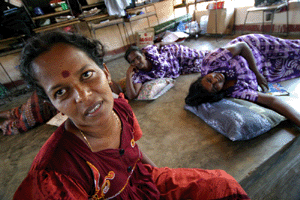
Refugee camp in Muthur
I enclose, with minimal comment, a letter I have just received. I think it is from a former student of mine.  The only comment I will make is that what is going on in Trincomalee is, in my book,  “mass murder’ or even ‘genocide’. One could ‘dress’ these up and call them by some other name eg ‘fighting terrorism’, ‘defending the nation’ etc, but mass killing is mass killing, genocide is genocide, whatever the dressing.  It is for us to point this out to the international community which continues to supply the gun boats, bombs and rockets for these atrocities to continue. 
Can I comment further on this letter? Of course I can but I will not do so in any detail. I will leave it to you to decide, now that I have drawn your attention to the facts on the ground. I will only make few observations which you might not appreciate. 
1. What the Sri Lankan Armed Forces are doing in Trincomalee is not “bad”, it is much worse than “bad”. It is not cruelty, it is beyond cruelty and into the realm of barbarism or savagery, take your pick. By extension, those who direct such behavior and/or are in a position to stop such atrocities, are guilty of the same.  
Am I accusing President Rajapakse of barbarism? Yes I am. Am I accusing President Kumaratunga of barbarism a la the bombing of Jaffna with half a million people in 1995 and the 'disappearances' of people who have been held without charge or trial in custody, their bodies subsequently recovered from mass in Chemmani? Yes I am. Do I believe the Sri Lankan Army Corporal, a Sinhalese, I might add, when he gave evidence under oath in the Supreme Court in the Krishanthy murder trial, that he and his fellow soldiers were asked to bury people (it was he who told us where they were buried) who were not yet dead? Yes I do.  Am I accusing President Jayawardene of barbarism a la the July 1983 massacre of Tamil civilians in Colombo when he and his cronies opted to watch the massacre or even encourage it? Yes I am. 
Let us not try to do some ‘dressing up’ to make these (including what is now going on in Trinco), look better than they are. Let us tell it like it is. This is barbaric. Full stop. End of story. Amen. 
2. If the Sinhala South wants to be ruled by a barbaric regime, that is their choice. There is no need for the people in the North and East to be ruled by this same regime. The latter have voted overwhelmingly for a separate Tamil State ( at the 1977 Elections). There is no evidence to date that they have changed their mind, Mr Karuna not withstanding. 
Will the Tamils be better off under the LTTE? I do not know. What I do know is that they cannot possibly beworse off. As I have said in an earlier communication, a recent (2005) survey in the Government-controlled areas in the North East, showed that some 85% of people wanted the ISGA implemented i.e. to be ‘ruled’ by the LTTE. Are they wise or mad? I do not know, but it is their choice. Had such a study been conducted in the LTTE-controlled area, I’d say the result would be somewhere near 100%. That is speculation, so shall we have a vote? And will the international community force the Sri Lankan Government to accede to the wishes of the people, as shown by that vote? If not, then there is no point getting the information. 
3. To negotiate with such a regime is an exercise in futility, comparable with the folly of prolonged negotiations with the Chandrika Kumaratunga regime. All that it achieves is for the Sinhala regime to be given time to enhance its destructive power, the evidence of which was seen in Jaffna in 1995. We are going down the same road, with predictably the same results. I have no doubt that the LTTE realises this. Our role is to make sure that the International community knows this. That is where we, in the expatriate community, have failed so miserably. 
4. There is concern, justifiably so, of child recruitment by the LTTE. Just look at the right column in the table given below – the children under 5 years of age who are going though what they are.  That is where the LTTE recruits are going to come. I can be sure of 3 certain recruits. These are the 3 children who watched their mother bleed to death with a severed hand, the ICRC desperately trying to get her to Trincomalee Hospital, and being not allowed to do so by the Army. There, for sure, are three ready-made recruits for the LTTE, the ‘Black Tigers’ and the suicide squad. 
5. The Sinhala Government is too stupid to realise that Eelam is not a creation of the Tamils or even of the LTTE. It is a creation of Sinhala ethno-religious chauvanism and State brutality. The division of the country is not going to come because the Tamils wanted it, but because it was forced on them by the abysmal stupidity of a succession of Sinhala Governments since Independence, especially since 1956. It is too late now to turn the clock back. Indeed, the events now unfolding in Trincomalee are turning the clock forward at a spectacular rate."..The Sinhala Government is too stupid to realise that Eelam is not a creation of the Tamils or even of the LTTE. It is a creation of Sinhala ethno-religious chauvanism and State brutality. The division of the country is not going to come because the Tamils wanted it, but because it was forced on them by the abysmal stupidity of a succession of Sinhala Governments since Independence, especially since 1956. It is too late now to turn the clock back. Indeed, the events now unfolding in Trincomalee are turning the clock forward at a spectacular rate..."
My first reaction on reading the letter I received was to catch the first plane and get to Trinco to be with my people in their greatest hour of need. Yes, they are my people although they speak a different language. However, I think that I will be of greater use to them if I stay alive here than go to Trinco and be killed like my friend Joseph Pararajasingham.
The very least I can do for these people, who are paying for what they have not done, is to apprise the International community of what is going on. This is what I tried to do in my earlier article on The killing of innocents in Sri Lanka(27.4.06). Here is now a Report from the ground, the ‘ground reality’. You can do what you like with it. If it is going to the dustbin, let it go. If mass murder and genocide are acceptable, so be it.
Attention of Dr Brian Senewiratne                                Muthur.      5 May 2006
The situation in Muthur
Dear Dr Senewiratne,
Despite the chaos here, we have seen your recent article on the killing of innocents in Trincomalee. We are grateful you, a Sinhalese, for pointing this out, when the so-called Monitoring Mission does not seem to have the guts to do so.
We are sending you some facts and figures to apprise you of the extent of the suffering.
People in Muthur are being displaced some 15 km to areas of supposed safety. I doubt if any place here is safe. It certainly does not seem so from what has happened so far.
People are on the road, literally camped under trees. I enclose a photograph but I have far worse ones which I am not sending you for obvious reasons. A few days ago, people with no where to go and tired of wandering about, decided to move back since the bombing seemed to have stopped. But then the shelling from the Naval boats started again, and the people are going back to ‘safe places’ again.
The SL military is preventing people from moving to safe areas, both in Trincomalee and Batticaloa.
Sampoor Hospital, which is the nearest hospital to these people, is essentially closed because there are no doctors. Eachchilampattu Hospital is the same. Doctors are understandably reluctant to come because of the bombing.  
The LTTE Thileepan mobile medical service is giving emergency medical and wound care, but there is a limit to what they can do.
You would have read that a mother of three children died of bleeding following the severing of her hand by a missile. ICRC tried to carry her to Trincomalee but was stopped by the Sri Lankan Army and she bled to death.
Here are some statistics from Health Care Centres in the region which you might have already seen:
LocationFamiliesIndividualsUnder 5  years of age
1.Thankapuram
402
1308
75
 2. Partarlipuram
1505
4660
175
3. Nallur
189
615
unknown number
4. Illankai thurai
674
2470
240
5. Punnaiyadi
507
1911
96 
6. Kalladi
145
425
26 
7. Verukal 
298
1680
61 
Total
3720
13069
673+
 This is the same area which has been devastated by the Tsunami and about which the Sri Lankan Government, despite claims to the contrary, has done absolutely nothing. They are now being bombed by Forces of the same Government.
Doctor, we really have no one to turn to. The children and infants are in real risk of dying unless help arrives fairly soon.Thank you, doctor, for what you have done to tell the world of our plight.
Kind regards
Sivakumaran

Wednesday, 30 March 2005

Solving the Ethnic Problem - Foreigners Have the Answer

I have been going through my analysis “Sri Lanka.The Peace cannot be abandoned” written after the January 2002 Ceasefire and still on the net, looking at the current impasse and where we are heading. I was about to put pen to paper to analyse the events that have occurred in the past three years, with the Ranil Wickremasinghe Government dragging its feet, the failure of the Kumaratunga Government to even move its feet, and the JVP threat to derail the Government if it did, and finally the post-tsumani reconstruction effort which treated the devastated Tamil area in a step-motherly fashion, if that. Where do the Tamils stand? What are their options? Is it to wait in hopeful anticipation, something they have done for years? Is it to watch the Sri Lankan Armed Forces go on yet another military hardware buying spree, tsunami or no tsunami? To watch and wait while their people starve? What are their options?


Trying to get an article together, I had a sudden wind-fall. It had all been done, far better than anything I could have produced. By whom? A foreigner, Ms Verena Graf, Secretary General of the International League for he Rights and Liberation of Peoples. This is a Geneva based NGO with Special Consultative Status at the United Nations. Here is what she said at the 61st Session of the UN Commission on Human Rights on Friday 19 March 2005.


The Tamils in Sri Lanka 


"The hopes for a peaceful settlement of the conflict in Sri Lanka in the wake of the ceasefire agreement of February 2002 between the then government and the LTTE as sole authentic representative of the Sri Lankan Tamils have largely proved illusory. 


"Long before disaster struck the island on December 26, 2004, negotiations had been suspended, cooperation largely ceased in the face of the continued occupation of huge tracts of land in the North East by the Sri Lankan army in the name of 'high security zones', of hundreds of thousands of refugees and internally displaced persons waiting in vain to be able to return to their homes, of lack of investment for the reconstruction of the destroyed countryside. 


"The new government that came to power in 2004 has not advanced the peace process, on the contrary it contains parties totally opposed to any negotiated settlement. If anything, the tsunami that has particularly affected the coastal areas in the North East, already suffering from war related destruction and very poor in comparison to the rest of country, has worsened the situation. 


"While it galvanised the common people of all communities to come to each others‘ help, the government did not follow suit. Instead of a joined effort at reconstruction and national integration the international aid has been instrumentalised for political purposes. In the name of relief measures, the distribution of aid and the planning for reconstruction have been highly centralised in the president’s office and handpicked committees at the expense of the immediate victims, including local NGOs or the Tamil Rehabilitation Organisation working in the LTTE controlled areas. 


"International media accounts as well as local parliamentarians have complained of government inefficiency, if not outright discrimination of the people in the North East, that includes Tamils and Muslims. More over, emergency regulations have been reintroduced, and the army put in charge of the welfare centres. Following the most recent official arms‘ purchases or the government‘s refusal to allow the UN Secretary General in early January to visit LTTE controlled areas devastated by the tsunami, have further raised suspicion that the government‘s true intentions aim not just at isolating the Tamils and their leaders but to use the catastrophe to change the balance of forces on the ground and to effectively renounce any negotiations. 


"In the Norwegian facilitated peace talks, the LTTE had agreed to renounce for the time being the Sri Lankan Tamils' right as a nation for an independent homeland Tamil Eelam and to explore the possibilities to redress decades of collective discrimination within the frame-work of large-scale internal autonomy. 


"The developments during the last three years compounded by the post-tsunami experiences raise the spectre that time is running out; that there is no hope for the Tamils within a united Sri Lanka, that their only chance lies in fighting for external self-determination." 


Ms Graf has got it right first shot! What she said could have been said, indeed much of it has been said, by Adrian Wijemanne, Subramaniam Sivanayagam, Wakeley Paul, Satchi Sri Kantha, Kumar Ponnambalam, Brian Senewiratne, and numerous others. But they are all “Tigers”! Thank God the above quoted gem came from someone who could not possibly be a Tiger or a Tigress.


Two things are important:


1. That we go in search of other ‘Verena Grafs’. They sure are around. It is only a question of contacting them and soliciting their help. Arundhati Roy, the outstanding Indian author and human rights activist, one of the best brains in India who is not afraid to say things that have to be said, Bishop Desmond Tutu who has, for years, expressed serious concern at what is going on in Sri Lanka, Malcolm Frazer, former Prime Minister of Australia, who has increased in stature in leaps and bounds after he quit politics, the outstanding former Irish President and later the head of the UN Human Rights Commission, the incomparable Mary Robinson, are just a few who spring to mind. I am sure there are many more. They are the people who are in a position to generate international pressure, particularly on the crucial ‘aid givers’. Rather than hallucinate about ‘Peace’ in Sri Lanka and then being surprised when fighting breaks out again, this is what we should be doing.


2. That we send a copy of Verena Graf’s 2005 presentation to every member of Parliament in whatever country we live.


Let us get this straight. Without sustained and massive international pressure, not a speech here and a speech there, we will get nowhere. It is this type of pressure that enabled the outrageous apartheid policy in South Africa to be dismantled. It is this that is needed if Sri Lanka is to be saved from total destruction, both physical and economic.


If we do nothing and wait for Eelam War 4 or 5 or whatever it is (I have lost count) to break out, we are as guilty as the JVP, the politically active Buddhist clergy, the Sri Lankan Armed Forces and Arms dealers who are currently in the economic doldrums, and President Chandrika Kumaratunga whose prime interest is in manipulating the situation to continue her political career rather than doing what has to be done to achieve, not just ‘Peace’ but ‘Peace with Justice’ in Sri Lanka. Let us not claim that we have no role to play. We have a vital role, which we prefer to ignore, since it is more convenient to put the blame on someone else. It is pathetic when we demand from politicians and political opportunists a level of integrity and responsibility which they simply do not possess. 


Brian Senewiratne                                                                   Brisbane, Australia

Friday, 18 February 2005

Subramaniam Sivanayagam


Sivanayagam,”Siva”, needs no introduction. He is one of Sri Lanka’s most famous journalists who has written more than anyone else on the problems facing Sri Lanka in general, the Tamil people in particular. As I wrote in the Foreword to his earlier book “The Pen and The Gun” (published in 2001), “Siva is an expert with the pen and has used this God-given gift with courage, determination and at tremendous cost to himself and his family for nearly two decades.” It should have read “five decades” since it was in 1953 that he started his career in journalism.

I am not a fast reader nor a consistent one. With mind cluttered with my medicine, human rights, the state of our public hospitals, the horrors in Africa etc, I cannot read a book from cover to cover. Siva’s “Witness to History” was the exception. I got it on Thursday, I read it all day and for most of the night till Sunday, covering the 683 pages, reading even the Index! So will you if you are fortunate enough to get this book. It is compulsory and addictive reading.

It is difficult to describe this book, let alone review it. It is not just memoirs (as Siva claims), it is not a narrative, it is not a history book. Remarkably, it is all of these. I can best describe it as “A historical narrative by someone who was in the thick of it and deeply involved.”
You will find in it details of events that have not been published in any other book - not one that has come my way. It will now be my reference book. When I am asked (as I often am) about some event that occurred in, say 1940 or 1957 or 2004, my response will be “Let’s see what Siva has in his book”. This remarkable book takes you through ‘History’, the way History should be presented. The oft-quoted dictum of the legendary editor C.P.Scott “Comment is free, facts are sacred” has been strictly adhered to. You will find facts, masses of it, recorded accurately and untwisted, and ‘comment’ which is not only free but fair and unbiased. Siva’s book, like all his writings, displays journalistic integrity at its best.
Priced at much less that the cost of a restaurant dinner (UK$40, Canada $50, Australia $50 and Euro 30), it is, if anything underpriced. A Tamil friend of mine says that it is ‘expensive’. Excuse me while I laugh. All I can say is that I will rather skip a dinner and buy this book. My friend went on “The Tamils are not great readers”. If that is true, I know not since I am a Sinhalese (!), this ‘deficiency’ will be corrected if they read the writings of this outstanding journalist and author.
Siva will not make a fortune on this book, nor was this his intention. He says that the book is his way of saying ‘farewell’ to his many friends in Britain as her returns to Sri Lanka. We can only hope and pray that his bone-marrow cancer (myeloma) will be properly treated there so that the wish of that truely great Sinhalese, Adrian Wijemanne, who wrote the Foreword, can be fulfilled: -
“One must hope that Mr Sivanayagam will not lay down his pen and will continue to dazzle us with this brilliant exposition of the great cause to which he is committed.”
The book is published by Sivayogam, 180-186 Upper Tooting Road, London SW 17 7EJ, and distributed in UK and Europe by Jasmine Studio, 45B Crusoe Rd, Mitcham,Surrey,CR4 3LJ, and in the USA and Canada by World NT, 36 Carisbrooke Sq, Toronto, ON M1B4M4, Canada, and in Sri Lanka by Vijitha Yapa Bookshop 130, S de Jayasinghe Mawatha, Nugegoda. Amazingly, there is no distributor (yet) in Australia but I guess if you contact me  (briansen@bigpond.net.au ) I will get you a copy. It is the least I can do for the man and his mission. Internet shoppers can buy it on-line at http://www.orupaper.com/witness/

Brian Senewiratne           Brisbane, Australia

Monday, 10 January 2005

Tsunami Disaster & Tamil Eelam Tsunami & Sri Lanka: Emerging Realities

With commendable enthusiasm, the international community, Church groups, NGOs, and other ‘do-gooders’ have rushed to help restore the damage done in South Asia. Where Sri Lanka, one of the worst hit, is concerned, there are serious problems emerging in the delivery and distribution of aid that is pouring into the country. The trusting international community may not be aware of some of the factors responsible and the underlying problems.


The background.
Over the past two decades a deep ethno-religious split has occurred between the Tamil minority and the majority Sinhalese-dominated Government (for the record, I am a Sinhalese). In the face of continuing discrimination in the use of their language(Tamil), education, employment and the developmental neglect of the area they live in (north, northeast and east), the Tamils (12.5% of the population) have been asking for a federal or separate state. With peaceful non-violent Tamil protests being met by Government-sponsored violence, in 1972 the Tamil Tigers embarked on an armed conflict to establish a separate Tamil state in the North and East. After 30 years of one of the most destructive conflicts in Asia, in February 2002 a ceasefire was negotiated between the Tamil Tigers and the former Sri Lankan government under Prime Minister Ranil Wickremasinghe. Since then, the guns have been silenced but the basic problems underlying the conflict have not been resolved.


In late 2003, President Chandrika Kumaratunga, from the other side of the Sinhalese political divide, using her sweeping executive powers, sabotaged Prime Minister Wickremasinghe’s parliamentary tenure, precipitating yet another General Election, four years ahead of schedule. Following the election, her party formed Government in December 2003. The new government, with extreme anti-Tamil ‘Marxists’ (read ethno-religious chauvinists) in its fold, has been dragging its feet in political negotiations with the Tamil Tigers, putting the ‘Peace’ under threat. A resumption of the fighting, a possibility pre-tsunami, would have seriously damaged Kumaratunga’s political career and even more so the massive foreign aid package of US$4.5 billion, negotiated by the Wickremasinghe government, and promised on condition the peace process would go forward (which it was not).


As a result of the 20-year war in northern Sri Lanka, the Northeast came under Tamil Tiger control. With a complete absence of government administration in this devastated area, the Tamil Tigers have, over the years, established a quasi-separate state with its own army, police, law courts, administration, infrastructure, and rehabilitation and reconstruction programs. The writ of the Sri Lankan Government does not even run in this area.


The tsunami hit the south coast (which is under the Sri Lankan government) and, causing even more devastation, the northeast (which is under the Tamil Tigers).


Political thinking and actions.
Even in the face of a national disaster, ethnic and political considerations are never too far away in Sri Lankan thinking, in particular in the minds of the Sinhalese politicians of all parties. The best example of this is a recent statement by President Chandrika Kumaratunga that the Tamil Tigers had lost too many cadres in the tsunami disaster to resume the armed struggle. This is an outrageous comment from a national leader whose country has been decimated. Faced with a national crisis from an unavoidable natural disaster, all that the President could do was to focus on what ‘benefit’ it could be towards settling her political problems. There can be no better example of the narrow-mindedness of Sri Lankan politicians even when faced with a major humanitarian disaster, with nearly 40,000 killed (probably more), many thousands whose lives have been shattered, two million rendered homeless, and extensive damage to two thirds of the coastline and those who live and work in this area. The President’s insensitive and irresponsible comment should not only be condemned, but should be noted by the international community since it has a direct bearing on aid, its delivery, and even its use and abuse in Sri Lanka.


The actions of the Sri Lankan Government, match this thinking. For five crucial days after the tsunami struck, the entire Government focus was on tourist resorts in the South, which was what the world saw and where the foreign aid went. Not a scrap of foreign aid arriving in Colombo was sent to the Tamil northeast and east, which suffered some of the greatest destruction. Aid that this devastated area so desperately needed came from the expatriate Tamil community, mainly via the Tamil Rehabilitation Organisation (see below), international NGOs and church groups, and civilians, both local and foreign. With increasing international concerns about what the Sri Lankan government was not doing, the Government belatedly sent some aid, although grossly inadequate in relation to the destruction, a situation which continues to this day.


The result of this neglect of the Tamil areas is a serious increase in preventable deaths and disability of the people in this area (mainly Tamils). A single quote from an Australian volunteer doctor, David Young, operating in this area, illustrates this. “Too many of the people will be left crippled, not because the injuries are that bad, but because the treatment they are receiving is woefully inadequate”. Doctors, both local, expatriate and foreign, working in the East and Northeast, are amputating limbs simply because they do not have the basic screws, plates and pins needed to fix broken bones.This is just one example. There are many more that have resulted in unnessary suffering, permanent disability and even death.


The Sri Lankan Government is guilty of criminal negligence, which has nasty ethnic overtones. It is up to the international community and foreign governments, and Sri Lankan civil society to do something about this and see that the donated money and goods go where they are most needed. This may not be ‘diplomatically easy’ but we are here talking of the lives and future of thousands of poor people (as we were in Rwanda, Ethiopia and innumerable other places) and diplomatic protocol has no place. To do otherwise is blatant hypocrisy that has devastating humanitarian consequences.


News
For many years, news out of Sri Lanka has been either Sri Lankan government propaganda or Tamil Tiger propaganda. Today, with international media roaming around the country, it is unnecessary to rely on either of these sources since independent reporters are there to report the situation as it is. The picture that emerges from these and other reports from international journalists forms the basis of this article.


The ground realities
1 The Sri Lankan Government
The Sri Lankan Government, in striking contrast to the Thai government, seems to have been completely unable to handle the situation. The infrastructure, organization and competence which are so necessary to handle a disaster of this magnitude, simply does not seem to exist. One wonders what the Disaster Management Unit of the Presidential Secretariat under President Kumaratunga, no less, was doing. The result of this disorganization was that aid even to the South, which is so readily accessible, faced problems in its delivery.


As for the East and Northeast, there is not only the inability to do so but also a highly questionable resolve to do so. For example, 24 hours after the wave struck, the Government summoned a meeting of all Parliamentary parties to discuss the management of the disaster. In the two-hour conference, the situation in the northeast, that had borne the brunt of the damage, was discussed for less than five minutes. A factually correct comment came from an MP from the area “They simply are not bothered about the plight of our (Tamil) people.” With 4% of the time spent in discussing an area which took nearly 60% of the damage and from 50% of the casualties came (of the 30,000 dead, 9,500 are confirmed dead from the North and another 10,000 missing), the comment is entirely justified. It should open the eyes of aid-givers that about 4% of their aid will reach this area if its delivery is left in the hands of the Sri Lankan government.


The Sri Lankan President, emerging at last from her holiday, breezed into Colombo and immediately set about marginalizing what her own Prime Minister, Mahinda Rajapakse, had been commendably doing with the Opposition Leader, Ranil Wickremasinghe. Rajapakse was told that there was enough to be done in his home town in the South and that he should not be running around the rest of the country!. The crude message was to go home and stay there. The reason for this extraordinary request was that any build-up of the Prime Minister’s profile had to be prevented. Not even a tsunami was sufficient to prevent the internal squabbles of the governing party. Such is the pettiness of Sri Lankan politicians.


The President, falsely claiming that nothing was done in her absence, went on to duplicate what the Prime Minister had done, setting up a ‘task force’ to rebuild the nation, handle rescue and relief , and maintain order. The Tamil Tigers (wisely) declined to be part of this since it is likely to turn out to be no more than yet another obstacle for potential aid-givers to negotiate on a road already cluttered with bureaucratic obstacles and even roadblocks.


The Tamil Tigers
As has been mentioned, some of the most serious damage is in the area controlled by the Tamil Tigers. They have a crucial role to play in the delivery of aid to this area and the east. The Tamil Rehabilitation Organisation (TRO), widely described as a “Front for the Tigers” is a major body that has been in operation for over 19 years and has extensive experience and expertise to translate ‘relief effort’ to ‘effective relief’. With district offices and sub-offices in all 18 districts in the Tamil area, an office in Colombo, and employing some 3500 paid staff, the TRO has been partners with several international NGOs and UN agencies in major reconstruction and rehabilitation programs in the Northeast over a long period of time. The question at issue is not whether it is, or is not, a ‘Tamil Tiger Front’ but whether it can deliver. The answer seems to be ‘Yes, it can’. If the alternative is the lethargic, disorganized, incompetent and disinterested Sri Lankan Government, then the TRO is on an entirely different plane. You will find the TRO details on http://www.tsunami-trocsc.com , www.troonline.org  , www.trousa.org .


If the TRO can deliver, it makes sense to let it do so. Recognizing this, even the Sri Lankan Government permitted the TRO to engage in rehabilitation and reconstructive work in both the Tamil Tiger controlled area as well as the Sri Lankan military controlled area in the northeast. However, whatever the Government says, its Armed Forces and Police have ideas of their own – to obstruct the work done by the TRO in the East, an area where the devastation was particularly severe. In an unbelievable act, bordering on treason, the Sri Lankan Army and the ‘Secial Task Force’ of the Police, has just moved into the refugee camps in the East and have taken them over from the TRO. It is difficult to believe that the Executive President, the Minister of Defense, the Minister of Reconstruction and Rehabilitation, the Head of the Disaster Management Unit of the Presidential Secretariat, and the Commander-in-Chief of the Armed Forces, who all happen to be one person, Chandrika Kumaratunga, was unable to prevent or reverse this.


The NGOs and Church groups.
A number of NGOs (World Vision, Red Cross, OxFam, Care Australia, UNICEF and Caritas) are doing an outstanding job in raising money and delivering what they can where they can. The Executive Director of World Vision (Australia) the dynamic Rev.Tim Costello, brother of the Australian ‘Prime Minister in Waiting’ who incidentally has been waiting a long time!), has just returned after visiting both the South and the Northeast of Sri Lanka. The Australian public has raised an amazing $15 million dollars in a single day supporting a cricket match for World Vision.


By naming the large NGOs, I am in no way trying to down play the outstanding contributions of small groups, especially small Church groups, and even individuals Details of each by typing out the name of the NGO on the google search engine.


An important point is that ANY of these Organisations would be a safer bet than the Sri Lankan Government until such time, if ever, that it gets its act together.


Foreign Governments
Foreign governments, big and small from across the world, have been commendably generous. India was, as expected, first off the block, flying in six helicopters to rescue victims, following this up with huge amounts of medical supplies, food and other relief supplies. Later two entire field hospitals with over 70 medical personnel and medical supplies arrived.


Dragging its feet was what the US was doing. With international eyebrows raised, when it finally decide to act, it was to play geopolitical games. Some 1,500 American troops have landed, supposedly to help and are busy establishing camps. Warships, probably three, are anchored off the Sri Lankan coast. What are they doing other than irritating India? Predictably, India has ‘expressed concern’ adopting a “I don’t want that boy to be in my backyard’ attitude.


Let me digress to deal with US aid. If the US really wanted to help Sri Lanka, it could pressure American companies operating in Colombo to pay even a little more than the $1/day they are paying impoverished Sri Lankans to sew denim jeans which are sold at $100 each. Sending 1500 troops and even three ships is not an alternative. The tsunami will not wash away the injustice and misery of slave labour in sweatshops.


The Australian public has been magnificent, perhaps more so than any other people. The collections for a country with only 20 million people have been unbelievable. It feels good to be an Australian. As I write, some of Australia’s best musicians are performing at the massive Sydney Opera House to a packed audience, the proceeds to go to the tsunami victims. “Cricket Australia’ with Asian cricket groups organized a match, raising over $15 million in a single day. The Australian Government, however, has behaved in an extraordinary way. At a major international donor meeting in Jakarta, Indonesia, on 6 January 2005, Prime Minister John Howard pledged A$ 1 billion for Indonesian Aceh. Aceh has been ravaged and no one will begrudge the funds, but so has Sri Lanka, Phuket and South India. There are a fair few Sri Lankans, Indians and Thai who live in Australia and pay their taxes. Howard’s generosity with their money, by-passing the desperate needs of countries which were once home to these people, is nothing but a slap in the face to a significant number of Australian citizens. That Aceh is a mineral-rich area (like oil-rich East Timor in which Australia also got involved) and the others (Sri Lanka, Thailand, South India) have no exploitable minerals or oil, I gather, had nothing to do with this highly questionable decision. If Howard wants to play geopolitical games and enter into ‘sweetheart deals’ with Indonesia to mend fences broken by Australia’s East Timor intervention, he should have chosen a more appropriate venue.


As for the United Nations, an incredible situation has arisen. UN Secretary General, Kofi Annan has just visited Sri Lanka. He toured the South, flew over Trincomalee in the East but avoided any contact (even from the air!) with the devastated Tamil Northeast. When asked whether he will be visiting the Northeast, his amazing response to Reuters news agency was “I am here on a humanitarian mission. I would like to visit all areas, but as you know, I am here as a guest of the government and they set the itinerary”. Clearly ‘the itinerary (read ‘interest’) of the Sri Lankan government does not extend to the Tamil areas (even aerially!).


The Sri Lankan newspaper the ‘Sunday Times’, not known to be critical of the Government, spilt the beans.
“Moves by senior UN officials based in Sri Lanka to schedule a visit by UN Secretary General Kofi Annan to inspect tsunami damaged area under control of the LTTE (Tamil Tigers) were stymied by the Government yesterday, fearing the visit would disturb the ‘south’.” Now we know where the Government stands, not that there were any doubts. UN officials privately vented their frustrations to Reuter “It is a relief visit, not a political one. The Secretary General wanted to go, but it didn’t happen” Well, if it ‘didn’t happen’ it is for the UN Chief to ‘make it happen’.
Can this be raised at the UN? It can but is unlikely. Sri Lanka’s UN Representative is, and has always been, a Sinhala representative voicing Sinhalese concerns, not Tamil ones. If the Tamils have a problem (which they have and have had for years) to expect the ‘Sri Lankan’ representative to voice it is completely unrealistic. The Tamils will have to get the Representative of some other country to do so, and that’s unlikely to happen however serious the problem. This is the reality of the UN, in effect a “Trade Union of Nations”, and a non-performing one at that. If the UN and its Secretary General cannot do the right thing, to expect this body to help the Tamil areas is quite unrealistic. All we can do is to cry “Shame” and say it loud and clear.


Amid the din of Sri Lankan Government voices shouting themselves hoarse about how much they are doing for the Tamil areas, one could hear the unmistakable clear shrill of Sinhala ethnic chauvinism and anti-Tamil discrimination that has devastated that country long before the tsunami.


Sri Lanka’s continuing war-stance
This is a problem that the international community and Sri Lankan civil society will have to take up with Sri Lankan government. Just four weeks ago the ruling United People’s Alliance Party and the main Opposition, the United National Party, supported by the Muslim party and the political party of the Buddhist clergy (incredibly some Buddhist monks in parliament), in a rare show of unity, voted to ‘beef-up’ the Armed Forces, allocating more than Rs 56.2 billion (US$ 536 million) for 2005. This is a 8% increase over the allocation in 2004.


In a recent publication “Sri Lanka’s military: The Search For A Mission”, Brian Blodgett, a career US Army officer and an Adjunct Professor in the American Military University, pointed out some ‘hard-to-stomach’ and even ‘harder-to-justify’ facts. While ‘Peace’ negotiations are in progress, the Sri Lankan Air Force bought 10 Mi-35 (a special export version of the Mi-24) helicopter gunships and 10 military transport planes. The Army doubled its artillery from 97 to 187. Armoured Personnel Carriers increased 70% from 158 to 204. The air force personnel nearly doubled from 10,000 airmen to 19,000, the army from 95,000 to 118,000 soldiers, and the navy from 18,000 to 20,000 sailors. These are indisputable signs that Sri Lanka is preparing for war, to inflict willful damage and destruction on its people, as if a natural disaster is not enough.


It is time that foreign governments, the international community, Sri Lankan civil society, the Churches, and NGO’s, started asking some hard questions since the tsunami notwithstanding, there is no indication that this outrageous military expenditure will be scaled down. What the international assistance, in particular monetary assistance, might do is to free-up even more funds for the Government to ‘beef up’ the Armed Forces even more to wage an even more destructive war which will cost even more lives of both the Tamils and the Sinhalese, especially the rural poor. Unless we get the situation clarified, our well-intentioned efforts might result in even greater destruction.


There is talk of debt-cancellation for tsunami-affected countries. The World Bank President James D Wolfensohn, is to visit Sri Lanka to “have a first-hand view of the destruction”. He should also have “a first-hand view” of the recent Sri Lankan budget and get the Government to justify the unconscionable allocation to ‘Defense”. The government response, as always when faced with hard questions, will be that this is ‘an internal affair of Sri Lanka’. The response to this should be ‘So is the devastation caused by the tsunami”.


If foreign debt is to be written off a guarantee will have to be written in that the money saved will be used for the development of infrastructure in all parts of the country, in particular, the war/tsunami damaged areas. This will, of course, have to be closely monitored, and if there is no co-operation, the debt repayments should recommence.


The long term
The devastation has been on a scale that it will take years to restore. The fear is that the wave of enthusiasm will come and go, like the tsunami itself. “To maintain the rage”, as former Australian Prime Minister Gough Whitlam asked the Australian public to do when he was undemocratically dismissed by Governor General John Kerr, may be difficult to do in the present crisis, as it was then. The question of long term aid is dealt with below.


Another fear is that Sri Lankan politicians seeing manna descending from heaven, will think up bigger and better ways to squander the money or use it for purposes for which it was not intended. This is the problem with pouring money into outstretched but unaccountable hands. One cannot lose sight of the fact that Sri Lanka and Indonesia are two of the most corrupt governments in South Asia. The tsunami will not wash away entrenched corruption. It might enhance it.


Sri Lanka and Indonesia are also two of the most repressive regimes in the area. The serious fear is that these repressive regimes will ‘use’ the destruction caused by the tsunami to crush the entirely justifiable separatist movements in both these countries. Should this happen, the damage done will be far greater than what the tsunami has done.


The situation in Aceh is very clear. Jakarta has ‘ruled’ the mineral-rich Aceh province down the barrel of a gun. The death of 100,000 Indonesians in that area is not going to change that. Indonesia’s army chief, General Rayamizard Ryacudu, admitted that a third of all soldiers deployed to the Aceh region were not there to provide aid but to secure control of the area. This is the regime into whose hands the Australian Prime Minister John Howard had just slipped in A$1 billion of Australian taxpayer’s money. The Sri Lankan Armed Forces’ agenda in the Tamil areas of Sri lanka is no different from that of their counterparts in Indonesia.


In Sri Lanka (and I guess in Aceh), the initial hope was that the warring parties in these on-going conflicts (the Tamil Tigers with the Sri Lankan Government, the Free Aceh movement with the Indonesian Government) would be ‘blown together’ by the tsunami. The Sri Lankan President shaking the hands of two Tamil Tigers seems to have mesmerized people. The reality is was that this was no more than politicians providing photo opportunities for foreign media. The reality was best put by Trond Furuhovde, leader of the Nordic ‘Peace’ mission to Sri Lanka who said “We should be careful not to draw conclusions too far. The disaster has done a lot of things to the country but has done nothing at all in (resolving) the conflict.”


Unrealistic optimism betrays a complete lack of understanding of what underlies these conflicts. The scales are now beginning to fall from the eyes of these optimists. All reports now agree that these expectations are far from reality. In fact, the opposite may well be the final result as the Tamils in the northeast see incontrovertible evidence of step-motherly treatment, or no treatment at all, at the hands of the Sinhala regime in Colombo.


What has occurred, post-tsunami, is a different kind of a ‘war’ with words, claims, and some inappropriate actions. What is definite is that neither the tsunami nor fighting is going to bring the elusive peace to Sri Lanka (and probably Aceh). Any attempt by either side to capitalize on any weakness, perceived or real, caused by this natural disaster will have no currency.


The Tamils of Sri Lanka have developed a deep distrust (not without reason) in the Sinhala-majority governments because of repeated violence suffered by them at the hands of Government-sponsored Sinhalese hoodlums and the Sinhala Armed Forces and Police. What the tsunami might have done is to give the Sri Lankan government the opportunity to establish its good faith among the Tamil people, especially in the Northeast, North and East, so that there would be a substantial increase in faith at any subsequent Peace talks. Regrettably, the Government seems to have failed to grasp this golden opportunity, the same tragic mistake made by a succession of Sinhala-dominated governments over the past 50 years for which the country has paid dearly.


What is amazing is that countries seem to learn nothing from the experience of others, or even from their own blunders. George W Bush learnt nothing from Vietnam and insists on repeating it in Iraq. Indonesia learnt nothing from East Timor and insists on repeating it in Aceh. Sri Lanka has learnt nothing from the Indonesian experience in East Timor and insists on repeating it in Sri Lanka. Ethnic conflicts based on the way people have been treated cannot be settled by military might or by a tsunami. To expect otherwise is to be naive and distance oneself from reality and history.


Long-term aid
To be realistic, Sri Lanka nor any of the other countries affected by the tsunami are going to get long-term aid. The current media attention and the funds it generates will be history in 4-8 weeks, 12 if we are lucky.


If long-term aid is not forthcoming, what are the alternative? The alternative, which may be as unrealistic as hoping for long-term aid, is to insist that Sri Lanka and numerous other countries hit by the tsunami (and others that have been spared), be paid a reasonable price for their produce and a reasonable wage for those who work in these countries. I have already alluded to the American companies paying a $1/day for $100 denim jeans. The list is endless. Tea pluckers in what were British-owned tea estates, and now increasingly, Indian-owned (but with Sri Lankan fronts to camouflage their true owners), pay less than $2/day for an 8-hour stint, picking tea at 6000 feet in freezing conditions, on treacherous slopes with no proper attire and no sanitation. The area is infested with leeches, snakes and hookworm. They (almost all are women) carry tea baskets on their backs which weigh more than their body weight. How do I know? I weighed them and their baskets in a research project that I did some years ago. That is the human cost of a cup of tea.


If thousands of fisherman in the North who have earned their living and have supplied fish to the rest of the country and for export, are prevented from fishing off the North and Eastern coasts of Sri Lanka because the Sri Lankan Navy claims that this is a “security risk”, there will be widespread poverty in the entire North and Eastern sea front. If hundreds of thousands of Tamil peasants in the North of Sri Lanka are prevented from cultivating their land because Sri Lankan army has declared that these prime agricultural lands are “security zones”, there will be widespread poverty. There will be widespread anger which sometimes manifests itself in outrageous acts of terror. Hundreds of thousands who are not capable of such acts suffer in silence.


If foreign aid comes with conditions which, if implemented, will make the poor poorer (as aid from the IMF and World Bank always do), then the country will be better off without this aid. If garments made by a tailor in Bangladesh or Sri Lanka are taxed twenty times more than those made in Paris or London, there will be suffering far greater than that inflicted by the tsunami.


No amount of ‘impulsive’ aid post-tsunami or post-some other disaster is an answer. What we are seeing is global injustice on a massive scale. The answer is global justice and this will not be delivered by aid, however impressive. The answer may well be in the actions of groups such as the World Social Forum (WSF) a small but outstanding group who are prepared to take on those who are responsible for this outrage. That is where our support should be directed if we are to have any long-term impact.


Current needs


The most urgent need is for people and organizations that are able to rebuild and reconstruct the damaged area without ripping off the country. Given the extent of the damage, it is a monumental task. It will be even more difficult given the incompetence, inefficiency, corruption, and bureaucratic road-block creating ability of the Sri Lankan government.


As for the Northeast, an added problem is its relative inaccessibility with roads completely destroyed by 20 years of war, a tsunami and the current floods from the onslaught of the north-east monsoon. If that is not enough, there is the major problem of overcoming the hidden agenda of the Sri Lankan government to keep this area in a devastated state if at all possible. There is not the slightest doubt that the organization most capable of doing the job is the TRO. There is also not the slightest doubt that the work of the TRO will be obstructed by the Government and/or its Armed Forces and Police. As I have alluded to, this is already happening. The challenge facing the international community is to confront the Sri Lankan government and expose that which is being concealed.


From the medical point of view, the needs are physical and mental rehabilitation, and the prevention of the spread of infectious diseases.


Physical problems are the treating of serious infections such as cholera and typhoid, and also tetanus which will become widespread given open wounds, contamination and the absence of vaccination. There are the problems of the physical rehabilitation of those who have lost their limbs or have suffered paralytic injuries.


There are serious problems with the rehabilitation of children who from a significant percentage of those who were injured or were orphaned.


Crowding people into refuge camps, which is inevitable in a disaster of this magnitude, invites communicable diseases such as cholera, typhoid and measles (currently at epidemic levels in Aceh). Measles in children in this scenario has a terrible mortality.


There is a major need for trauma councilors and doctors competent to deal with the psychological effects of major trauma, the mental effects of which are complex. There is the expected initial sadness and reaction to loss. That is normal human sadness for which trauma counseling is appropriate and adequate. Unfortunately, in some people this is followed by a definite psychiatric problem which manifests itself as a sleep disorder, a mood disorder with anxiety, depression and irritability, a loss of interest, difficulty in concentration and impairment of memory, fatigue, headaches, a variety of aches and pains, a drop off in performance, an inability to function and to cope. This is the syndrome of major depression for which no amount of counseling will be adequate. It is a biochemical disturbance for which chemical i.e drug therapy is necessary. If it is not properly treated, it can last years, with a complete functional breakdown, often ending in suicide. The human cost of unrecognized or poorly managed depression is horrendous. I doubt if all this is widely appreciated by lay people and even by many doctors.


In summary
In a disaster such as this, there is rarely any difficulty in raising money or goods. Such is the generosity of ordinary people across the world. The problem is its delivery to the affected people. If this is left in the hands of the Government, Sri Lankan or any other, it will not go where it is most needed. The entire effort of raising the aid will then be nothing but a betrayal of the trust of people who have given so generously to alleviate the suffering of the less fortunate. The damage done is many layered and unless at least some of these are addressed the aid may well be wasted. There are people in positions of power who have an agenda and a hidden agenda and it is our business to identify and address these. This is a lot harder than colleting aid but infinitely more useful. 


Brian Senewiratne                                                               Brisbane, Australia